
Socialising Equality
What happens when social expectations become one person's job?
Socialising Equality grew from observations I made while travelling and from experiences I later reflected on while writing my memoir. I began noticing how often particular social responsibilities were treated as one person's job, based on expectations attached to their sex, role or position.
I began wondering whether social connection works better when the responsibility is shared. One person can begin, but both people have the opportunity to contribute to what happens next.
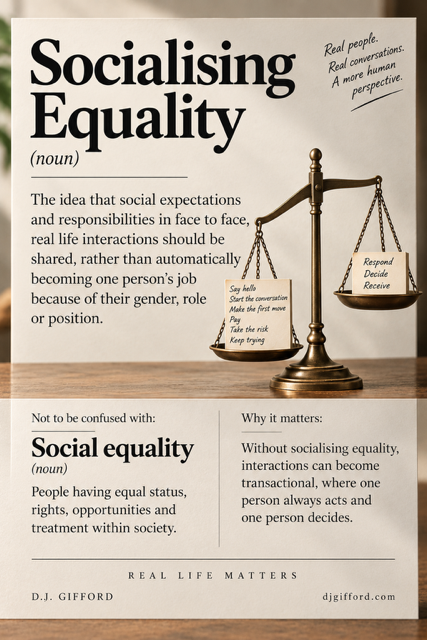
Socialising Equality is the idea that social expectations and responsibilities in face to face, real life interactions should be shared, rather than automatically becoming one person's job because of their sex, role or position.
Socialising Equality is not Social Equality
Social equality is about equal status, rights, opportunities and treatment within society. Socialising Equality is different. It is about the expectations we place on each other when we meet, interact and build connections in real life.
It does not mean everyone has to behave in the same way. People have different personalities, boundaries and reasons for choosing whether to talk. It is about questioning why certain social responsibilities are automatically expected of one person rather than shared between the people involved.
Why it matters
When one person is expected to provide the effort while the other person is expected to respond or decide, the interaction can become transactional.
“The responsibility for connection doesn't belong to one person.”
Give the conversation somewhere to go
Someone can say hello. Someone else can respond. A question can be answered with more than the minimum, and another question can follow. Little things can turn an ordinary interaction into a genuine conversation when both people allow it to happen.
The idea is not about finding the perfect question or turning every meeting into a meaningful conversation. It is about being willing to take the small social risks that allow people to discover something about one another.
“The important part was that somebody cared enough to ask one.”
What the idea made me notice
The more I thought about Socialising Equality, the more I noticed how many small parts of social connection are taken for granted. Who begins? Who asks the next question? Who decides whether a conversation continues? What happens when someone is willing to open up, but the other person is waiting for them to do all the work?
I don't think there is a single answer to those questions. What interests me is the possibility that we could make connection easier simply by recognising that both people have some responsibility for what happens between them.
“One person can create the opportunity, but connection requires both people to take part.”
Further thoughts
The Articles alongside this page explore different observations that grew from the same idea. Together they look at the small moments where connection begins, develops or quietly disappears.
The Articles take those observations further without needing to repeat the idea itself here.

No, I Won't Buy You a Drink!
The experiences came first. The ideas came later, after I had enough distance from the journey to notice patterns that were difficult to see while I was living through them.
Find the book