
The Bumachunski Challenge
20 June 2026
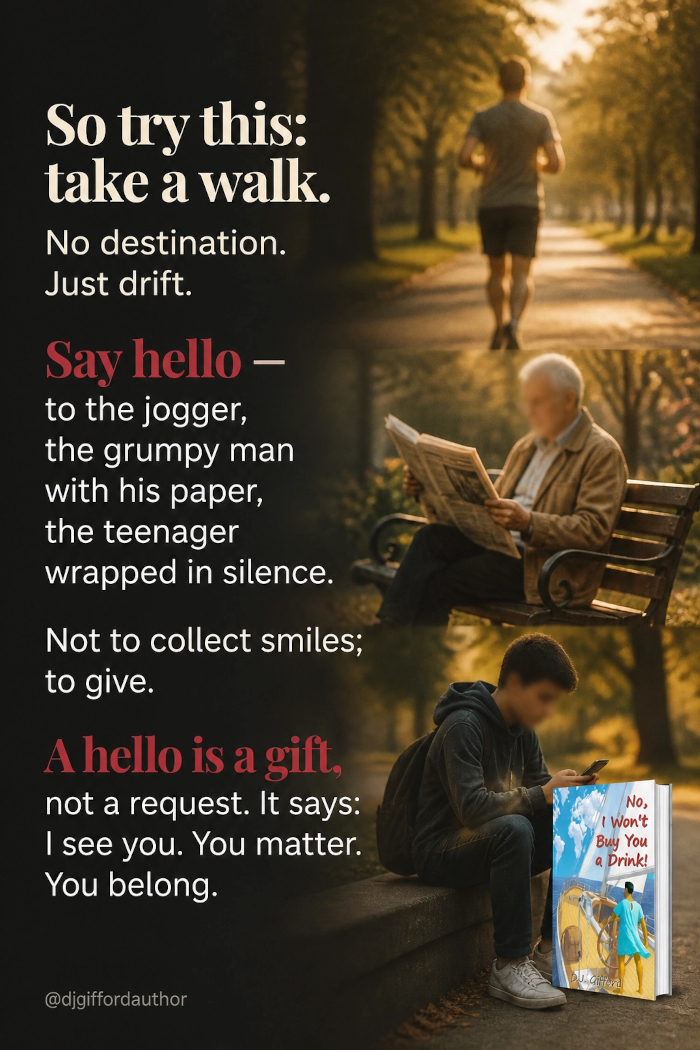
The Bumachunski Challenge first appears in my memoir, No, I Won't Buy You a Drink!, but the idea behind it had been quietly forming for many years before I ever gave it a name.
At its heart, the challenge is remarkably simple. It asks us to break the invisible habits that stop us acknowledging the people around us. Not online. Not through somebody else's opinion. Not through a screen. In real life.
On the surface, that sounds almost too simple to matter. Yet in a world where we're constantly connected to people we've never met, genuinely noticing the person standing beside us has become surprisingly uncommon.
For most of human history, we discovered one another the old-fashioned way. We talked.
Today we know astonishing amounts about celebrities, influencers, politicians and strangers on the other side of the world, yet often know very little about our neighbours, colleagues or even the people we see every day. That has always seemed backwards to me.
During my travels I met people from every walk of life. Some were successful, others were struggling. Some were funny, some were difficult, and many had lived experiences that would fill entire books. What struck me wasn't how different they were. It was how invisible those stories often remained. Most people are carrying experiences that would surprise us. The problem is not that those stories don't exist. The problem is that we rarely create the conditions for them to emerge.
Somewhere along the way, conversation became less about discovery and more about presentation. We learned how to introduce ourselves, promote ourselves and package ourselves. We became increasingly concerned with being seen, while gradually becoming less interested in seeing the people around us.
I've often thought that most people spend their lives collecting stories about people, while very few spend time collecting stories from people. One creates opinions. The other creates understanding. Sometimes the difference between the two is nothing more than a genuine hello.
Every time we stop to talk with someone, we create a first-hand experience. Every time we simply walk past, we leave room for assumptions, headlines and other people's opinions to fill the gap. Over time, those second-hand impressions quietly become our understanding of the world.
The Bumachunski Challenge was created as a small response to that problem. It isn't a social experiment, a performance or something designed to create content for the internet. The world doesn't need another video proving that strangers can be kind. Most of us already know they can.
The real challenge is becoming curious again. It's about noticing people, asking better questions and remembering that the most remarkable story in the room often belongs to the person nobody has taken the time to know.
As I continued writing, those simple observations gradually grew into something much larger. They eventually became part of The Ricardo Report, where I explore ideas about authenticity, attention, human behaviour and why meaningful connection sometimes feels more difficult despite living in the most connected age in history.
I don't pretend to have all the answers. If anything, the challenge simply asks whether we've been looking in the wrong direction. Perhaps the next great adventure isn't waiting on a screen or at the other end of the world. Perhaps it begins with becoming genuinely curious about the people already around us.
If enough of us accepted that challenge, I suspect the world would become a little less performative and a little more authentic. That seems like a worthwhile place to start.
Topics:
#BumachunskiChallenge #HumanBehaviour #HumanConnection #Authenticity #Observation #Conversation #DJGifford #AustralianAuthor #NoIWontBuyYouADrink #RicardoReport